
By Mark Thielman
In the March blog for MWA Southwest, Saralyn Richard described some chance meetings along her writing path, calling them “serendipitous.” Her words resonated with me, as I often feel my entire writing career has been marked by similar fortuitous encounters.
Webster’s defines “serendipity” as the fact of finding interesting or valuable things by chance. I consider these found things to be intellectual Easter eggs. I usually bump into them while looking for something else. Naysayers may call this process procrastination or stalling. I prefer the phrase broad net research.
My first novel began as a chance encounter with a cool fact. Avoiding real work, I allowed myself to be drawn into reading an internet article, “Ten Ancient Treasures Waiting to be Found.” Number Four on the list, the Scepter of Dagobert, I learned, was the oldest of the French crown jewels. It disappeared during the French Revolution and remains lost. More exquisite stalling occurred while I considered the question, where might it have gone?
The questions led to a storyline, and some months later, I completed the rough draft of The Devil’s Kitchen, the first book in my National Park series. This novel wouldn’t exist without the serendipitous intervention of dumb luck.
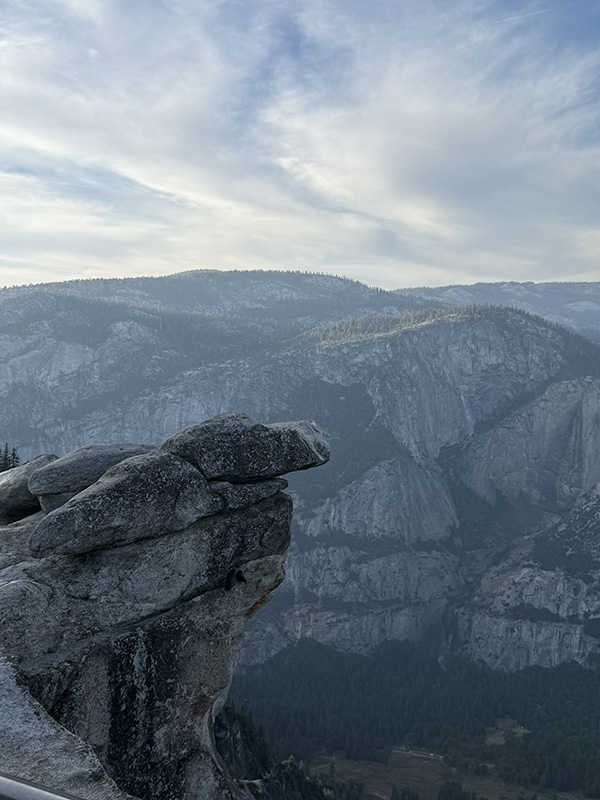
Fast forward to The Firefall, the latest in the series. It was released on April 14th. The third book is set in Yosemite. While researching there, I sat outside the Ansel Adams Gallery in the shadow of Glacier Point. I talked to one of the rangers about law enforcement in this majestic, rugged, and crowded national park. As the conversation ended, I told him that I’d thought about having my novel’s victim fall from Glacier Point.
The ranger said nothing for a moment, then, quite casually, he mentioned. “You know, everyone who trips, jumps, or is pushed from Glacier ends up in the same spot.”
No, I confessed, I did not. Although I’d read a number of guidebooks preparing for my trip to Yosemite, none of them mentioned the mountain’s common landing zone.
That final remark didn’t just close our conversation—it opened my story.
The second anecdote, I hope, illustrates two lessons of value to writers. Visit your setting, if possible. The things you learn on the ground may not be in a book or on Google Earth. Secondly, it illustrates the role of serendipity in our writing lives. We can become better about finding valuable things by chance. Being intentional, remaining open, and looking for opportunities are the keys to nurturing what I call “learned luck.”
Here are five ways all writers can cultivate serendipity:
Be open to surprise.
At the heart of serendipity is surprise. It is finding the metaphorical four-leaf clover is an unplanned event. For an encounter to have meaning, we need to let it grab our attention and recognize its uniqueness. Not all surprises offer immediate value. Tuck it away.
Be ready.
To borrow a line from Psychology Today, the brain is a meaning-seeking organ. It will try to instill order and find a place for the new observation. Besides being aware, use the skills that make you a writer—creativity and agency. Ask questions. Where might this discovery lead? A willingness to recognize and run with an unexpected encounter is what makes success possible. Serendipity flourishes when fortune meets human action.
Be confident.
Serendipity is subjective. The value of insight will vary between individuals. If others don’t share your enthusiasm, don’t be discouraged. It might be a warning, but not a reason to disregard the idea. Serendipity requires us to connect the dots. Others may draw the line differently. Don’t automatically abandon your route. You have your own subjective calculation about the idea’s worth.
Be intentional.
We can build a mindset for serendipity. Asking “why” more frequently, I think, helps us see the value of curiously out-of-place events. We’ll notice more if we challenge ourselves to try. Jotting notes allows us to reflect upon our observations at a more convenient time. Use your phone and grab a picture. We get sensory data shoveled at us. Preserving the things that strike us means we’ll have the prompt there for later. In thoughtful moments, the other reporter’s questions—”who, what, where, and how”—help us uncover links and connections.
Be yourself.
Finally, when we reflect, don’t be hasty about disregarding a thought. Self-censoring kills creativity. Allow yourself the opportunity to follow your musings. Taking the chance provides the opportunity for success. Recently on this blog, William Dylan Powell praised Rick Rubin’s book, The Creative Act: A Way of Being. Rubin asks how do we pick up on a signal that can’t be heard or defined? His answer is to create an open space that allows for it.
Psychology Today has called serendipity “active luck.” I like the expression. Discovery is a combination of opportunity and receptiveness. Both may be cultivated. When it happens, we may feel like the lucky beneficiary. But I don’t think we give ourselves enough credit. We’ve trained ourselves to be this lucky.
A former prosecutor and criminal magistrate, Mark Thielman lives in Fort Worth, Texas. An award-winning author, Mark writes novels and short stories. His dual timeline thrillers in the Johnson and Nance series are set in the splendor of America’s National Parks.




Great advice! I think one take away from your post for me, personally, is to get out from behind my computer. Over the years I think I’ve come to an appreciation that if you don’t get out into the world, and let that serendipity happen, you won’t have as much to write about. People talk A LOT about the pitfall of not being disciplined enough to sit at the desk and make the magic happen, but there’s much less talk about the pitfall of not getting out into the world to find those interesting moments, connections, insights and relationships.