
By M.E. Proctor
Three years ago when fellow crime author Russell Thayer suggested that we write a short story together I had never written any piece of fiction with anybody. My only collaborative experience went back to an economic policy report with a fellow researcher, after college. I remember that we worked well as a team and produced a hefty document that we were both happy with. Russell’s proposition was very different. But a short story, okay, it couldn’t be too taxing and if it didn’t work, so be it. I was willing to try.
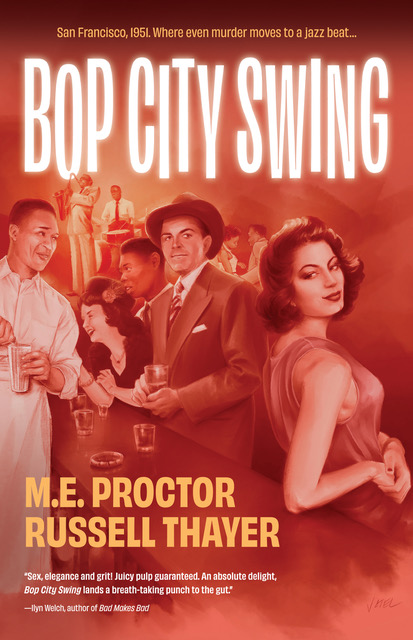
The short story became a novel, Bop City Swing. As we exchanged ideas, mostly during late night online chats and emails, we quickly realized that the plot had too many moving parts for a few thousand words.
There are as many forms of writing collaborations as there are writers. Russell and I came to the project with a history. Our respective characters were already well-developed. He had written a number of short stories featuring Vivian Davis, aka Gunselle, a killer-for-hire, in the California of the forties and fifties. I had a dozen published stories built around a mid-century San Francisco PD homicide detective, Tom Keegan. Putting a professional assassin and a cop on a collision course was interesting. What would connect them? We decided that we wouldn’t write a classic cat-and-mouse chase with him hunting her. It was a lot more exciting to have them work together. By accident. She would know he was with the police, but he wouldn’t know she was a killer.
The story structure flowed naturally from that point. Russell would write Vivian’s scenes, in her point of view, and I would write Tom’s.
We never discussed how to proceed. We just started writing. The premise was a political assassination in San Francisco in 1951. A mayoral candidate gunned down during a fundraiser. I wrote the crime scene chapter, the arrival of the cops, first clues, first suspect, Tom as lead investigator, and sent the material to Russell. He covered Vivian’s presence on location—she was scoping the place for a hit and was pissed off that somebody took out the target before she could; she vowed to get to the bottom of it.
We sent the master document back and forth and edited on the go, adding little details and side characters. At around twenty-five thousand words, we regrouped. We needed a timeline and an outline, and our two characters who had been working the case separately had to meet.
Who would write that critical scene? We decided to write both versions. It was a juicy segment, full of sexual innuendo and tension, in the pulp noir tradition. Vivian’s angle proved to be the strongest. She was the dominant character and she drove the action. There would be another climactic scene toward the end where Tom took the lead.
Neither of us knew how the book would conclude. We played with multiple options and what-ifs and landed on a finale that neither of us had foreseen.
I don’t know if our personalities are particularly well-suited for that kind of four-hand playing but the experience was so satisfying that we immediately decided to go for another round, even before we had secured a publisher for Bop City Swing. We shared a love for classic noir cinema and a fondness for the pulps. Diving into the time period was cool and we felt that our two characters had more mileage in the tank.
As anybody who’s ever tried to write a series knows, the second book is tougher than the first. There’s baggage and expectations.
Russell had spent some time in Kansas City and wanted to set the plot over there. It required some brainstorming. Why would a SF cop go to Missouri and why would he team up with a woman who he now knows is a professional killer?
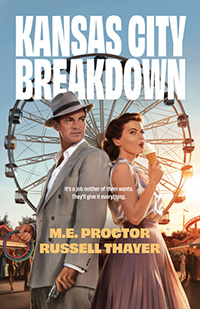
For Kansas City Breakdown, released in April, the story revolved around an undercover FBI operation: infiltrate a Mob meeting. The ‘soft’ target is a San Francisco mid-level mobster who’ll travel to KC by train. The Feds’ plan is to put a woman in his entourage. Tom Keegan knows just the person, but will she agree to do the job? Let’s say that a financial opportunity will convince Vivian Davis to go along for the ride. Of course, nothing goes the way it’s supposed to …
Our collaboration had worked well before and Russell and I didn’t see a need to change anything in our methods. Once again we chatted frantically at night, writing over each other with possible plot points, dropping ideas, bringing in new ones, creating supporting characters so strong that they threatened to steal the show. These things happen.
As I write this we are in the first stages of Number Three. The year is 1953 and we’re back in San Francisco dealing with the moral murkiness of the Red Scare. The tone will be dark and the fight pitiless. But Tom Keegan and Vivian Davis are resilient. They have proved it. I’ll keep you posted …
Bop City Swing and Kansas City Breakdown are published by Cowboy Jamboree Press. The covers were designed by Frank Vatel. Available in paperback and eBook, at Amazon and Bookshop.org.
Buy Links:
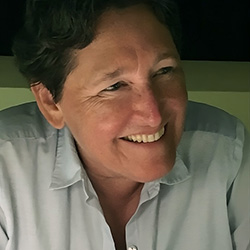
M.E. Proctor was born in Brussels and lives in East Texas. She writes the Declan Shaw detective mysteries (Love You Till Tuesday and Catch Me on a Blue Day). She’s the author of two collections (Family and Other Ailments and A Book to Live By), and the co-author of the retro-noir novels, Bop City Swing and Kansas City Breakdown. Her short stories have appeared in various magazines and anthologies. She’s a Shamus Award and Derringer Award nominee for short fiction. On Substack at https://meproctor.substack.com.




What a fun collaboration! Sounds like great chemistry.
Thank you for reading!
I’m fascinated with your description of your collaborative processs, which suggests it was by correspondence. The only writing collaborations I am very familiar with are songwriting and screenwriting. I remembering being surprised that, unlike modern day songwriters who sat together at a piano, Gilbert and Sullivan wrote their operettas by mail. This was because in Victorian times the librettos, including the lyrics, were written first. Their differing personalities were also a factor. As for planned screenwriting (as opposed to situations were one writer reworked the script of another like Stoppard’s beefing up Norman’s screenplay for Shakespeare in Love), I remember how director Howard Hawkes was asked what sort of collaborator William Faulkner was in the four credited screenplays Faulkner worked on for him (Road to Glory, To Have and to Have Not, the Big Sleep, and Land of the Pharoahs). Hawkes couldn’t remember a particular scene or line Faulkner wrote but did say he was an active member of the collaborative process–suggesting something that someone else would modify that Faulkner would modify that someone else would modify. The way you describe your collaboration with Thayer sounds exciting but dangerous, like walking a tightrope where you can either triumphantly get to the other side or end up in a net, if there is one.
Now that we are working on collaboration #3, it doesn’t feel that dangerous, I assure you 🙂 … Actually, there’s a confidence that we will pull it off. The note about not remembering what Faulkner wrote is spot on. When the story is done, the collaboration is so blended that it’s unclear who wrote what. i like that.
Love this, Martine! And what a great title for the piece, capturing the energy, mild chaos, and creative power of collaborative writing.
Thank you for reading!